
Massage can support recovery from a muscle injury, and early research suggests it may calm inflammation in damaged muscle tissue. The strongest “faster and stronger” findings so far come from a study in mice. In people, timing matters most: rest the muscle for the first few days, then add hands-on work, then rebuild strength.
The headline that inspired this question is real. In 2021, researchers at Harvard’s Wyss Institute reported that repeated, controlled compression helped badly injured leg muscles in mice recover better, and that more force produced stronger muscles. Their press release was titled “Massage doesn’t just make muscles feel better, it makes them heal faster and stronger.”
What that study means for a pulled hamstring or a strained calf in Aurora is a narrower story. It is worth telling carefully, because the timing of a massage matters as much as the massage itself.
At True Balance Pain Relief, we treat strained muscles and sports injuries, and we start with an assessment rather than a technique. Below, we walk through what the research shows, what each stage of healing needs, and where massage fits.
If you are nursing an injury right now and are not sure whether it is ready for massage, contact us and we can talk it through before you book anything.
Table of Contents
- What the Research Actually Shows About Faster and Stronger Healing
- Days 1 to 3: Protect the Muscle Before Anyone Massages It
- The Following Weeks: Where Hands-On Work Starts to Help
- Rebuilding Strength Is the Part Massage Cannot Do Alone
- When an Injury Needs a Doctor Before a Massage Therapist
- Back to Full Strength in Aurora, One Stage at a Time
- Frequently Asked Questions
What the Research Actually Shows About Faster and Stronger Healing
Two studies sit behind most claims that massage speeds muscle healing. One, in mice, found that controlled compression improved recovery of severely injured muscle. The other, in 11 young men, found that 10 minutes of massage reduced inflammatory signals in exercise-damaged muscle, though neither proves that massage heals a human injury faster.
The mouse study, published in Science Translational Medicine in 2021, used a robotic device to press a soft silicone tip into injured leg muscle on a repeating cycle. The authors reported that compression “within a specific range of forces” substantially improved functional recovery.
Part of the benefit came from clearing immune cells called neutrophils out of the injured tissue. Left in place, those cells and the signals they release may slow the growth of new muscle fibers, the authors wrote. The Wyss Institute added that the greater the force applied, the stronger the injured muscles became.
The human study, published in the same journal in 2012, was much smaller and shorter. Researchers massaged one thigh of each of 11 young men after hard exercise and left the other thigh untreated, then compared muscle biopsies taken before, immediately after the massage, and 2.5 hours later.
The massaged muscle showed lower production of two inflammatory signals and more activity in the pathway that builds new mitochondria, the parts of a cell that produce energy. Massage made no difference to lactate or glycogen levels in the muscle.
| Study | Who | What changed | What it does not show |
|---|---|---|---|
| Harvard Wyss Institute, 2021 | Mice with severely injured leg muscle | Better functional recovery; immune cells cleared faster; more force, stronger muscle | That a hands-on massage does the same for a person |
| McMaster University and Buck Institute, 2012 | 11 young men after exercise-induced muscle damage | Lower inflammatory signals and more mitochondria-building activity 2.5 hours after a 10-minute massage | Faster healing of a strain or tear over weeks |
The Wyss team said it wants to confirm the approach in larger animals, with the goal of testing it in people. Until that work is done, the honest summary is that massage looks promising for muscle repair, and the details of timing and pressure still matter a great deal.
Days 1 to 3: Protect the Muscle Before Anyone Massages It
For the first couple of days after a strain, the muscle needs protection first. The NHS advises avoiding heat, alcohol and massage during that window. AAOS, the national academy of orthopedic surgeons, recommends rest, ice, compression and elevation, known as RICE, as the first step.
A strain is a stretched or torn muscle or tendon, according to MedlinePlus, the National Library of Medicine’s health site. Pain, muscle spasms, swelling and trouble moving the muscle are the usual signs.
The orthopedic surgeons’ guidance on RICE is specific. Use a cold pack for 20 minutes out of each hour, several times a day, and never put ice directly on the skin. Wear an elastic compression bandage to limit swelling, and raise the injured area above your heart while you rest.
The research does not change that advice. Even in the Wyss mice, the benefit came from force “within a specific range,” applied by a machine under controlled conditions, which is a long way from a hands-on session on a fresh injury.
If you want something useful to do in this window, book an assessment. Knowing what is injured, and how badly, decides everything that comes next.
The Following Weeks: Where Hands-On Work Starts to Help
Once the first couple of days have passed, hands-on work can begin, guided by an assessment. Treatment at our clinic is first aimed at reducing pain and supporting healing, then moves into reconditioning to restore strength, and the pace of that move depends on how the injured muscle responds.
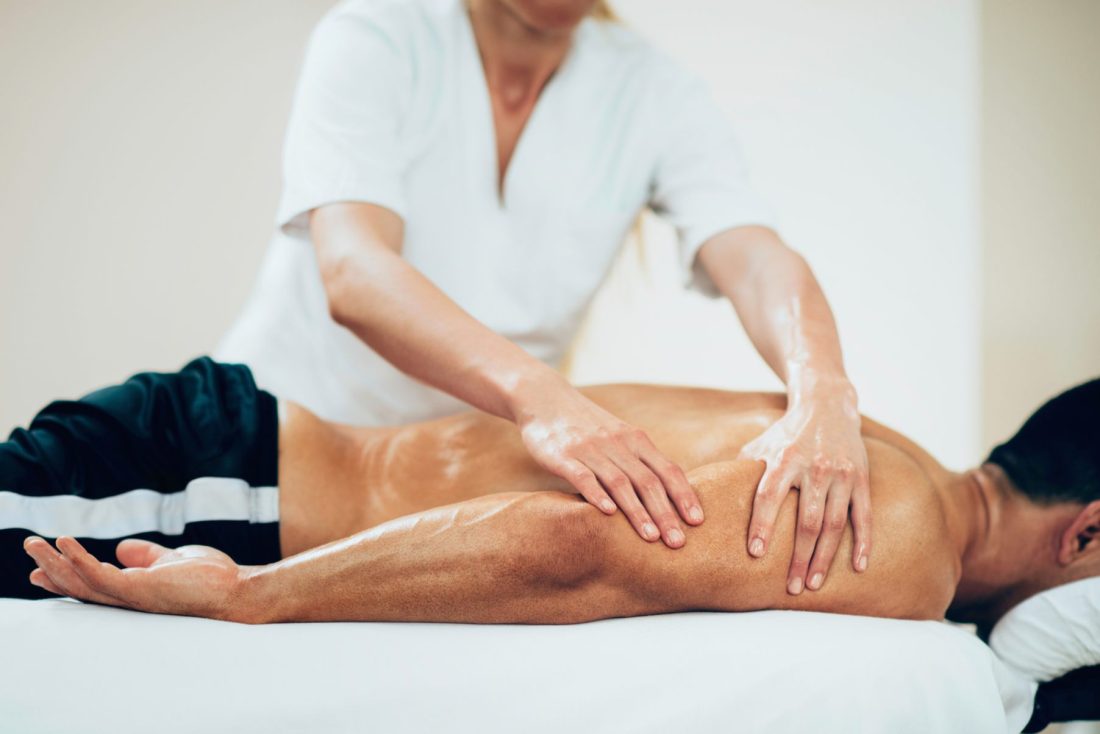
The assessment decides where in that sequence you start. We check how well you can move, how far you can stretch, and how strong the muscle is when we push against it. Those findings decide where we work, how deep we go, and what we leave alone for now.
Most strains improve on their own timeline. The NHS says most sprains and strains feel better after 2 weeks, while severe ones can take months to get back to normal.
Massage works within that timeline and cannot shortcut it.
As for which type of massage is best, the injury and the stage of healing decide that, which is why we assess before we choose a technique. Our guide to deep tissue massage versus trigger point therapy explains how those two compare.
Deep tissue work deserves a word of caution. The National Center for Complementary and Integrative Health says the risk of harm from massage appears to be low, but that some rare serious cases have involved vigorous types of massage, such as deep tissue massage.
Rebuilding Strength Is the Part Massage Cannot Do Alone
Massage can ease pain and help a muscle move again, but strength comes back through loading the muscle with the right exercises at the right time. The orthopedic surgeons’ guidance pairs early care with simple exercises to relieve pain and restore mobility, then a gradual return to sport.
For people, the guidance on getting stronger is about exercise and gradual loading, with massage in a supporting role.
That is why injury recovery at our clinic includes a written restorative exercise plan. It records your goals and what the movement assessment found, and we adapt it as you progress. Common goals are restoring full range of motion, a normal walking pattern, muscle strength and endurance.
Pace matters as much as the exercises. The NHS advises avoiding strenuous exercise such as running for up to 8 weeks after a sprain or strain, because of the risk of further damage. The orthopedic surgeons’ advice for returning to sport is to start slowly and give your body time to adjust.
We also check in after your sessions end, to see whether your goals are being met and whether anything has changed. If you are working out how often to come in while you rebuild, our post on how often to get a sports massage covers frequency for recovery from a specific injury.
When an Injury Needs a Doctor Before a Massage Therapist
Some injuries should be seen by a doctor before any massage. The NHS lists hearing a crack at the moment of injury, pain that is very bad or getting worse, and an injury that is not improving with self-care. The orthopedic surgeons add that any symptoms that persist need a doctor.
The National Center for Complementary and Integrative Health also cautions against using massage therapy to put off seeing a health care provider about a medical problem. A massage therapist can tell you when something looks beyond massage, but we cannot diagnose a tear or a fracture.
Numbness, tingling or weakness after an injury is another reason to see a medical provider before booking soft tissue work.
If you are unsure where your pain fits, our guide to choosing the right therapy for pain explains how to decide between seeing a doctor and booking hands-on care.
Back to Full Strength in Aurora, One Stage at a Time
An injured muscle heals in stages, and massage helps most when it matches the stage. Protect it for the first couple of days, add hands-on work once an assessment shows it is ready, and rebuild strength with a written exercise plan that changes as you progress.
Here at True Balance Pain Relief, our injury recovery follows that order. We assess first, treat what the assessment shows, and give you a written exercise plan that fits where you are in your recovery.
You can read more about how we handle sports injury recovery in Aurora, or see what to expect at your first visit.
When your injury is ready for hands-on work, book a session online, or talk through your injury with our team first at 970-389-9200.
Medical Disclaimer: This content is for general informational purposes only and is not a substitute for medical diagnosis, treatment, or individualized advice from a qualified healthcare provider. Massage therapy is not a replacement for medical care. If you have severe, sudden, or worsening pain, or any numbness, weakness, or tingling, please see a medical provider before booking soft tissue work. Individual responses to massage vary.
Frequently Asked Questions
Can a muscle strain be massaged out?
Massage cannot remove a strain, because a strain is a stretched or torn muscle or tendon that needs time to heal. After the first couple of days, massage can be one part of recovery alongside rest and exercise, guided by an assessment.
How soon can you massage a strained muscle?
The NHS advises avoiding massage for the first couple of days after a strain. After that, hands-on work can begin once an assessment has checked how far the muscle can stretch and how much strength it has. See a doctor first if the pain is severe or getting worse.
What type of massage is best for injuries in Aurora?
No single type is best for every injury. The right choice depends on what is injured and how far along it is in healing, so an assessment should decide it. Some of the rare serious side effects of massage on record involved vigorous types such as deep tissue massage.
Should you massage a torn muscle?
Not in the first couple of days, which the NHS advises keeping free of massage. A torn muscle should be checked by a doctor, especially if you heard a crack, the pain is severe or it is getting worse. Massage can play a part later in recovery, once a provider has assessed it.
How massage helps injured muscles heal faster and stronger in Aurora?
In mice, controlled compression improved recovery of severely injured muscle and cleared out immune cells that can slow repair. In people, a small study found massage reduced inflammatory signals after hard exercise. Strength itself comes back through a gradual exercise plan, with massage supporting it.